
Delhi's overall air quality index (AQI) stood at 463 at 11.30 am, according to the System of Air Quality and Weather Forecasting and Research (SAFAR).

Uttar Pradesh, last year, recorded the most 2,60,028 deaths attributable to air pollution, followed by Maharashtra at 1,08,038 and Bihar 96,967, it said.

In a three-page letter written to 40 farmer leaders, Joint Secretary in the Ministry of Agriculture and Farmers' Welfare Vivek Aggarwal said, 'I again request you that the government has been discussing all issues with open heart and good intention to end the protest, and will continue to do so. Kindly suggest a date and time (for the next round of talks).'

Thousands of farmers have reached the national capital on their tractor-trolleys and other vehicles, responding to the 'Delhi Chalo' call against the agri-marketing laws enacted at the Centre in September. On Saturday morning, it wasn't clear if they will agree to move to the Burari ground on the outskirts of the city, where police said they can continue with their protest. Many protesters were demanding a better venue in the centre of Delhi. Originally, the protest was meant to be on November 26 and 27.

'The answer is no, the entire country's is.' 'So why such obsession with Delhi?' 'But the most powerful people in India live here: The prime minister, civil servants, Supreme Court judges, MPs, diplomats, dadas of the media...' 'If they can't deal with their own problem, what chance does the rest of the country have, with its foul air, dying rivers, frothing lakes, and crumbling mountains?' says Shekhar Gupta.

A day before the eighth round of talks, the government and the farmer unions stuck to their respective positions on Thursday -- the agitating farmers took out tractor rallies to press their demand for rollback of new agri laws and the Centre asserted it is ready to consider any proposal other than their repeal.

'If there is no outcome at Tuesday's meeting, then on the 30th thousands of tractors and farmers will march on the Kundli-Manesar-Palwal Expressway.'

Among the key demands of agitating farmers has been a legal guarantee on minimum support price (MSP). The protest reached a crescendo when thousands of farmers from Punjab and elsewhere marched towards Delhi late last year and decided to block the main entry points once they were denied entry. The Centre, on its part, held 11 rounds of discussions with the protesters and even offered to amend some of the provisions without much success. With now one of their chief demands met, farmers have now moved on to force the government to concede on MSP.

'Visiting my friend in his affluent locality, I realised that the Delhi weather had become the great equaliser.' 'Pollution was always in the air, everywhere, and had become the primary subject of all conversations,' notes Ambassador B S Prakash.
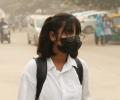
'Pollution acts as an endocrine disruptor.' 'When it acts as an endocrine disruptor it has an effect on the endocrine system of the human body and the effect on the pancreas is an important one.' 'The way you get type two diabetes is due to two defects.' 'One is the pancreas doesn't produce enough insulin.' 'The other physiological defect is insulin resistance.'

Long-term exposure to chronically high PM2.5 levels weakens the ability of the lungs to fend off infections, therefore making people more susceptible to COVID-19, the scientists said.

For over three months, the three Delhi border points at Singhu, Tikri and Ghazipur have transformed into townships occupied by thousands of farmers from different parts of the country, mainly Punjab, Haryana and western Uttar Pradesh.

'Had these three farm laws existed it would have become a huge election issue.'

Kejriwal's centralised way of governance might work in Delhi, but Punjab will call for delegation, observes Sanjeev Nayyar.

What did Mamata and Yogi, who were seated one seat away from each other, say to each other, we wonder.

In a gross violation of a Supreme Court order, people in several cities burst firecrackers until at least midnight, two hours after the 10 pm deadline. Loud bangs rent the air in New Delhi.

With CPCB saying that the air quality is not severe now, the SC partially lifted its ban.

In a statement, Delhi Health Minister Satyendar Jain said the air pollution had reached the severe level and asked people to follow the dos and don'ts as mentioned in the advisory.

The seventh round of talks between protesting unions and three central ministers ended inconclusively on Monday as the farmer leaders insisted on the repeal of the three contentious farm laws right from the beginning, even as the government listed various benefits from the Acts.

While Delhi boasts of one of the best metro systems in the world and decent infrastructure, reckless construction, legalising unauthorised colonies, and the worsening water and air quality dent its image of being a robust cosmopolitan city.

Farmer leader Joginder Singh Ugrahan said told reporters after the meeting that the unions urged the government to repeal the three laws, but the Centre was unwilling to do so. "We decided to meet again on January 19 at 12 pm," he said.
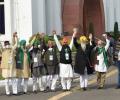
Farmer leaders said the government sought more time for internal consultations to present a final proposal in the next meeting to resolve the issue.

'Amit Shah needs to understand that we are not against Hindus. But we need to preserve our ethnic character.'

Doctors and experts say that besides spike in fresh cases, health complications have aggravated in people having a history of asthma, allergy or other related ailments.

Union leaders, who came out of the meeting venue shouting slogans, said the talks remained deadlocked and some of them threatened to boycott any further meetings if no solution was found at Thursday's meeting.

The President's assent to these bills comes amid the Opposition criticising the manner in which they were passed in Parliament.

NHRC issues notices to Centre and governments of Delhi, Punjab and Haryana, saying 'the state cannot leave its citizens to die due to the toxic haze.'

"Have you heard him singing Rinkiya ke papa," Kejriwal talked about Delhi BJP chief Manoj Tiwari.

The Kartarpur corridor was an excellent opportunity for the Congress to seize centre-stage in Sikh religious affairs. After all, the Akalis never achieved this in their years in power, says Sanjeev Nayyar.
Delhi government's odd-even scheme was launched in the national capital on Monday with common citizens giving it a mix response.

'Respect nature, working with (it) rather than against it.'

Sticking to their key demand of the repeal of three farm laws to end their protest, farmer leaders on Friday told the government their 'ghar wapsi' can happen only after 'law wapsi' but the Centre insisted talks must be limited to contentious clauses and ruled out a complete withdrawal of Acts.

As the issue remained deadlocked with both sides sticking to their respective positions, Prime Minister Narendra Modi, while laying the foundation stone for a new Parliament building, invoked Guru Nanak to underscore the importance of dialogue and noted that the Sikh Guru had said that interaction should continue till eternity.

The overall air quality index was recorded at 426 which falls in the 'severe' category, according to data by the Central Pollution Control Board.

The air quality in Delhi is turning worse, Deputy Chief Minister Manish Sisodia said.

With seasonal crop residue burning, coupled with vehicle emissions, calm winds and low temperatures persisting for some time, the thick layer of toxic smog has hovered over the national capital.

India's state-run NTPC is launching bids for clean technology for two coal-fired power plants near New Delhi, officials said, as criticism mounts over the country's failure to end a toxic smog which strikes the capital every winter.

The AIBA Women's World Boxing Championships is taking place in an indoor stadium from Thursday through to November 24 but teams are complaining about a toxic smog hanging over the city, caused by seasonal burning of crop stubble and emissions from vehicles and industry.

Union Environment Minister Harsh Vardhan welcomed the apex court's order and urged people to abide by the SC guidelines and 'give green Diwali and our environment a chance'

'While its people might be a little less resistant to changing for its greater good, New Delhi, unfortunately, is also evolving into an ugly city of which one must remain wary to survive its rising incidents of violence and crime,' says Kishore Singh.
